Start with the mud, not the marketing
Mud is not one surface. Thin mud over hardpack is slippery because there is little for the outsole to bite into. Deep mud needs lugs that penetrate and release. Sticky clay can turn almost any outsole into a smooth platform, while wet leaves and roots demand rubber that grips hard surfaces as well as loose soil.
Before choosing a shoe, think about your usual route and season. Ottawa runners often need a versatile model for damp spring trails, summer thunderstorms and late-fall leaf cover. If your regular terrain is consistently wet, steep or churned up by mountain bikes and hikers, a more aggressive shoe is usually worth the trade-off in comfort on pavement.
Trail shoe grip for mud starts with lug design
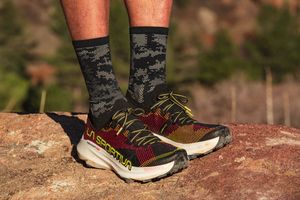
Lugs are the raised blocks on the outsole. Their job is to dig into soft ground, create braking edges on descents and shed debris as your foot moves through the stride. Deep lugs are useful, but depth alone does not make a great mud shoe.
For mixed local trails, lugs around 4 to 5 mm are often the practical sweet spot. They offer meaningful purchase in wet dirt without feeling overly harsh on dry hardpack, rock or short road connectors. A shoe with 6 mm or deeper lugs is more purpose-built for heavy mud, steep grass, soft forest soil and race courses that have been thoroughly churned up.
Spacing is equally important. Closely packed lugs can feel fast and stable on firm ground, but they are more likely to collect mud. Widely spaced, directional lugs leave room for mud to escape. Look for chevron-shaped blocks under the forefoot to drive forward, plus pronounced heel lugs that provide braking when descending.
Why self-cleaning matters
A sole that sheds mud restores its bite with every few steps. Flex in the outsole helps, as does open space between lug blocks. This is why an aggressive trail shoe can sometimes feel dramatically better after the first boggy section: mud is pushed out as the shoe flexes, while a shallow, tightly patterned outsole stays clogged.
There is a limit. In thick clay, every shoe can load up. When that happens, avoid trying to scrape your sole against roots or rocks at speed. A brief stomp in shallow water or a few deliberate kicks can clear enough buildup to make the next descent safer.
Rubber compound is the other half of traction
Lugs work in dirt. Rubber works when your shoe lands on wet root, slab rock, boardwalk or a hard, muddy surface where lugs cannot penetrate. A softer, tackier compound typically delivers more confidence on these surfaces because it conforms to small irregularities. The cost is faster wear, especially if you frequently run roads or gravel approaches.
Harder rubber generally lasts longer and can feel more stable on firm terrain, but it may be less reassuring on rain-polished rock. Premium trail shoes often use different compounds or strategically placed rubber zones to balance grip and durability. That is useful, but do not assume a heavily covered outsole is automatically better for mud. Full rubber coverage with shallow tread can be excellent on rocky trails and poor in soft ground.
If your runs regularly include wet Canadian Shield-style rock, roots and wooden bridges, prioritize a proven sticky compound even if the lug depth is moderate. If your route is mostly soft woodland or open, muddy fields, prioritize open, directional lugs first.
Fit keeps the outsole working
A highly technical outsole cannot help much if your foot slides inside the shoe. On off-camber trails and muddy descents, a secure heel and midfoot let you place weight precisely over the lugs. Too much movement causes hesitation and can leave your toes jamming the front of the shoe when braking.
Aim for a locked-in heel, supportive midfoot and enough room in the toe box for natural splay and downhill swelling. The best fit is not necessarily the narrowest fit. Runners with wider forefeet should not squeeze into a low-volume shoe simply because it feels race-ready in the shop. A cramped foot loses comfort and control as distance builds.
Pay attention to the upper as well. A light, quick-draining mesh is often the right choice for wet conditions because water escapes rather than staying trapped. A more protective upper can keep out splashes and trail debris, but once it is soaked, it may take longer to dry. For cold shoulder-season runs, pair a breathable shoe with appropriate socks rather than relying on a waterproof membrane for deep mud. Waterproof uppers are helpful in shallow wet grass and slush, but water that enters over the collar has nowhere easy to go.
Lace for descending, not just standing
Test the fit by walking down an incline or using a ramp if available. Your heel should stay planted without crushing the top of the foot. A runner's loop at the top eyelets can improve heel hold, while a small adjustment across the midfoot can relieve pressure without giving up control. These small fit details matter most when the trail asks for fast, repeated changes of direction.
Match the shoe to your training day
One pair does not need to do everything. A versatile trail runner with moderate lugs makes sense for most training, dry-to-damp singletrack and long days that include gravel or pavement. Keep an aggressive mud-focused pair for spring races, wet technical outings and days when you know the trails will be soft from start to finish.
The compromise is real. Deep, widely spaced lugs can feel vague and noisy on hard surfaces. They can also wear faster if used daily on asphalt. Conversely, a low-profile, fast-feeling shoe may be ideal for dry race trails but become a liability after a storm. Choosing purpose-built footwear is not overthinking it when the terrain changes your mechanics and confidence.