Start With the Terrain You Run Most
A trail shoe is a system: outsole rubber and lug shape manage traction, the midsole controls how the shoe feels under load, and the upper keeps your foot positioned over the platform. Start with the surface that makes up most of your weekly running, not the occasional race or destination adventure.
For packed dirt, rail trails, dry singletrack, and mixed urban-to-trail routes, a versatile shoe with moderate lugs is often the smart choice. Look for lugs around 3 to 4 mm, a stable platform, and enough cushioning to stay comfortable when the route includes pavement. Deep, widely spaced lugs can feel vague and noisy on hard surfaces, while a trail-to-road design makes everyday training easier without giving up useful grip.
If your regular routes involve wet roots, mossy rock, leaf-covered descents, and spring mud, outsole compound matters as much as lug depth. Soft, sticky rubber can provide noticeably better confidence on wet rock, although it generally wears faster on pavement and abrasive gravel. A 5 mm lug or deeper clears mud more effectively and bites into loose ground, but it may feel less fluid on fast hardpack.
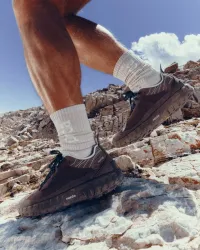
Technical mountain terrain calls for a more protective chassis. Rock plates, firmer sidewalls, toe bumpers, and a secure heel structure reduce the punishment from sharp rock and unstable landings. The trade-off is weight and ground feel. Runners who enjoy placing each foot precisely may prefer a lighter, more flexible shoe, while those logging long technical days often appreciate the fatigue reduction a protected platform provides.
Trail Running Shoes Need a Precise Fit
The most advanced outsole cannot compensate for poor fit. Trail running shoes should hold the heel securely, wrap the midfoot without pressure points, and leave enough room in front of the toes for downhill running. On a steep descent, your foot should not slide forward and repeatedly hit the toe box.
Fit the shoe later in the day or after a run, when your feet are closer to their training size. Wear the socks you normally run in and test both shoes, not just one. Walk downhill on an incline if possible. Pay attention to heel lift, toe pressure, and whether the lacing creates hot spots across the top of the foot.
Toe-box width deserves special attention. A generous forefoot can be excellent for runners whose feet spread on longer outings or who prefer natural toe splay. It is not automatically better for everyone. On off-camber trails, too much unused volume can allow the foot to move sideways inside the shoe, reducing precision. The goal is room without slop.
Lacing is also more useful than it first appears. A runner's loop, sometimes called heel-lock lacing, can improve rearfoot hold without crushing the forefoot. If a shoe feels good everywhere except at the ankle, this simple adjustment may solve the issue. If the shape is wrong through the midfoot, however, no lacing pattern will turn it into the right shoe.
Cushioning, Drop, and Ground Feel
More cushioning does not always mean more comfort. Higher-stack trail shoes can take the edge off long runs and protect legs from repeated impact, particularly on hard, rocky routes. They can also feel taller and less stable when cornering quickly or landing on uneven surfaces. Wide platforms and well-designed sidewalls help, but the sensation remains different from a low, close-to-ground shoe.
Lower-stack models offer more feedback and can feel exceptionally controlled on technical terrain. They ask more of the feet, calves, and ankles, especially late in a long run. If you are moving from a heavily cushioned road shoe to a minimal trail model, make the transition gradually. A few short trail runs are more useful than an ambitious first outing that leaves your calves tight for a week.
Heel-to-toe drop is another personal variable. A moderate drop can feel familiar for many runners and may relieve strain on the Achilles during longer mileage. Low-drop shoes encourage a more level platform and can suit runners who like a natural, stable stance, but they require adaptation if your body is accustomed to a higher drop. Do not choose based on trend alone. Choose the geometry that allows you to run efficiently and recover well.
Weather Changes the Shoe Choice
Ottawa trail conditions can shift quickly. A firm autumn route may become greasy after rain, while freeze-thaw cycles create a mix of bare dirt, ice, slush, and sharp frozen ruts. One all-purpose pair can cover much of the year, but runners who train consistently often benefit from rotating two trail shoes with different strengths.
A moderate-lug shoe works well for dry and mixed conditions, while a deeper-lug option earns its place in spring mud and wet technical terrain. In winter, traction becomes a safety issue rather than a performance detail. A shoe compatible with traction aids, or a purpose-built winter trail shoe, can make snowy and icy runs far more practical. Waterproof membranes can keep feet warmer in cold slush, but they are not automatically the best answer for every run.
In warm rain or deep puddles, a waterproof upper can trap water once it enters from the collar and dry slowly. A breathable, quick-draining upper may be more comfortable over longer wet outings. In cold conditions, the same membrane can provide welcome protection from snow and wind. Match the upper to temperature, exposure, and the likelihood of full submersion.