Tubeless versus clincher tires: the real difference
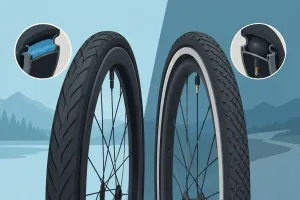
A traditional clincher setup uses three separate elements: a tire, a rim, and an inner tube. Air is held inside the tube. If a sharp object penetrates the tire and tube, the tube loses air and must usually be patched or replaced.
A tubeless setup removes the inner tube. A tubeless-ready tire locks tightly onto a compatible rim, while rim tape and a tubeless valve create an airtight rim bed. Liquid sealant inside the tire closes many small punctures as they happen. The tire still has a bead that hooks onto the rim, which is why terminology can get confusing. In everyday shop language, “clincher” usually means a conventional tire-and-tube setup, rather than the technical tire bead design.
Neither system is automatically faster or safer in every situation. What changes is how each system manages pressure, impacts, rolling resistance, and punctures.
Why tubeless has changed performance riding
The central advantage of tubeless is lower pressure without the same risk of pinch flats. A tube can be trapped and cut between tire and rim when you hit a sharp edge hard. Riders know this as a snakebite flat. With no tube to pinch, a tubeless tire can run at lower pressures for more grip and comfort.
On gravel, that can mean using a 40 mm tire at a pressure that lets it conform to washboard, roots, and loose corners rather than skipping across them. On mountain bikes, tubeless improves traction under braking and through turns while reducing the harshness that creates fatigue on longer rides. For road riders on 28 to 32 mm tires, lower pressure can also reduce vibration losses on imperfect pavement. Faster does not always feel harder.
Sealant is the other major benefit. Thorns, fine wire, and small shards of glass frequently create punctures that seal before you need to stop. You may hear a brief hiss, see a small spray of sealant, and keep riding. For racers and riders with limited training time, avoiding a roadside tube change is a meaningful advantage.
Tubeless can also reduce rolling resistance in many real-world applications. Inner tubes flex against the tire casing as the wheel rolls. Removing that interface can reduce friction, particularly with supple tires at appropriate pressures. But the tire model and pressure matter more than the word tubeless on the sidewall. An overinflated tubeless tire can still ride slowly and harshly.
Tubeless is not maintenance-free
Tubeless requires accurate setup and periodic attention. The rim tape must be intact and properly installed, the valve must seal, and the tire-rim combination must be compatible. Some tires seat easily with a standard floor pump; others need a high-volume inflator or compressor. Once seated, the system is reliable, but the initial installation can test the patience of even experienced home mechanics.
Sealant dries over time, particularly during warm weather or in a bike stored near a heat source. Check it every few months, and more often if your bike sees regular mileage. A tubeless tire that will not hold air often needs fresh sealant, a valve clean-out, or a careful inspection of the rim tape before it needs a replacement tire.
Large cuts can also defeat sealant. Carry a tubeless plug kit for holes that will not close and carry an emergency tube for a sidewall cut or damaged tire. Tubeless reduces the likelihood of stopping. It does not eliminate the need to be prepared.
When a clincher with tubes is the smarter choice
A conventional clincher remains a practical, dependable system. Tire installation is straightforward, replacement tubes are compact and inexpensive, and roadside diagnosis is simple. If the tire is flat, remove the wheel, inspect the tire, replace or patch the tube, and continue.
This simplicity matters for commuters, casual road riders, riders using older wheels, and anyone who wants to swap tires frequently. A winter tire change, a travel bike case, or a wheelset shared between road and indoor use can all be easier with tubes. Tubes are also useful when you need a specific setup that is not supported by your rim and tire combination.
For narrow, high-pressure road tires, traditional tubes once held a clear convenience advantage. That gap has narrowed as road tires have grown wider and tubeless technology has improved. Still, a rider using 25 mm tires at high pressure may find that tubes offer a more predictable, lower-fuss experience than forcing a marginal tubeless setup.
Modern TPU tubes are worth considering if you stay with clinchers. They are far lighter and more compact than standard butyl tubes, with lower rolling resistance in many cases. They do not provide the self-sealing benefit of tubeless, but they can make a tube-based road setup feel notably quicker and lighter.
The hidden downside of tubes
The main weakness is puncture vulnerability. A sharp object that reaches the tube generally means a stop. Pinch flats are also more likely when pressures are lowered for comfort or rough terrain. On gravel and mountain bikes, that often forces riders to use more pressure than they would prefer, compromising grip and control.
Tubes can also add heat and friction at the tire interface. This is less of a concern for everyday riding than fit and pressure, but performance-focused riders looking for every advantage will notice that premium tubeless systems offer more tuning range.
Choose by discipline, not by marketing
For mountain biking, tubeless is the clear recommendation for most riders. The ability to run lower pressures, improve cornering traction, and resist pinch flats is too valuable on technical terrain to ignore. Use a quality tubeless-ready tire, compatible wheels, and sealant suited to Canadian temperature swings.
For gravel, tubeless is similarly hard to beat. Whether you are riding rail trails, rugged cottage roads, or mixed-surface events, comfort and puncture protection allow you to maintain momentum.