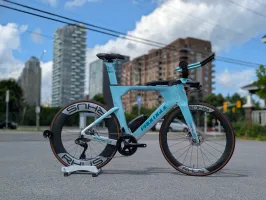
Time Trial Bike Configuration Starts With Fit
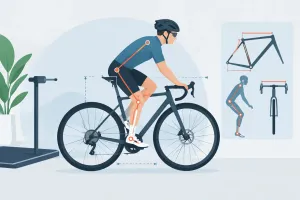
Your position is the largest aerodynamic decision on the bike. A deep rear wheel may save time, but it cannot compensate for a rider sitting up, reaching too far to the extensions or constantly shifting to relieve pressure at the hips and shoulders.
A strong TT position balances a low frontal area with sustainable power. That usually means a stable pelvic position, enough arm-pad support to relax through the shoulders, and a hip angle that still allows you to drive the pedals. More drop is not automatically faster. If lowering the front end closes your hip angle, reduces your power or forces you to lift your head excessively to see the road, the real-world result can be worse.
Saddle position deserves the same attention. A steeper effective seat angle often works well for triathlon because it can preserve the hip angle when you rotate forward into the aerobars. For a pure time trial, the best answer depends on your event rules, preferred pedaling mechanics and how aggressively you can hold the front end. Small changes to saddle height, reach and pad stack can be meaningful, so adjust one variable at a time and test it on the road or trainer.
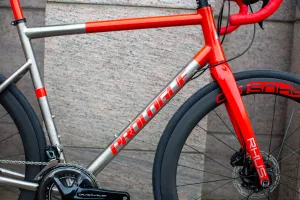
For custom builds, frame geometry matters because it determines whether the cockpit can be set correctly without a stack of spacers, an extreme stem or compromised handling. A properly selected frame gives you room to refine the position rather than forcing it.
Build the Cockpit Around Control
The cockpit is where aerodynamics becomes practical. Extension length, pad width, pad height and hand position all affect your frontal area, but they also decide whether you can steer confidently through rough pavement, crosswinds and corners.
Bring your hands too close together and your shoulders may narrow nicely, yet the position can feel twitchy. Set the pads excessively wide and you may gain stability but expose more frontal area. Many riders find their best balance with pads supporting the forearms comfortably, elbows under or slightly ahead of the shoulders, and extensions that let the hands sit naturally without straining the wrists.
Raised hands can help some athletes reduce drag by smoothing airflow around the arms and torso. They are not a universal upgrade. A higher hand position may require more extension rise, different shifters and a new approach to hydration placement. It can also make it harder to see ahead if the torso position is already low. Test it before committing to a major cockpit change.
Keep the front end clean. Route cables and hoses neatly, choose a computer mount that sits close to the extensions, and avoid turning the cockpit into storage. Nutrition and hydration still need to be accessible, especially in triathlon, but every item should have a purpose and a secure location.
Choose Wheels and Tires for the Course
Wheel depth should match your speed, handling confidence and wind conditions. Deeper carbon wheels generally offer a worthwhile aerodynamic advantage on flat and rolling courses, but the deepest available rim is not always the quickest choice. Gusty crosswinds can cost time if they make you grip the bars, avoid the extensions or brake more often than necessary.
A balanced setup often places the deeper wheel at the rear, where handling is less affected, with a slightly shallower front wheel for confidence. Disc wheels can be exceptionally fast on suitable courses, but check race regulations, transport requirements and expected wind before selecting one.
Tires are a speed component, not an afterthought. A fast-rolling tire at the right width and pressure can deliver more usable performance than an aerodynamic wheel paired with an overinflated, harsh-riding tire. Match tire width to the rim, use the manufacturer’s compatibility guidance, and account for rider weight, road texture and weather. Ottawa-area pavement can range from smooth and fast to frost-heaved and unpredictable within one route, so pressure that works on a perfect test loop may not be right for race day.
Tubeless setups can provide low rolling resistance and improved puncture protection, while a carefully chosen clincher and latex tube remains a competitive option for riders who value straightforward setup. The best choice is the one you can prepare, inspect and race with confidence.
Gear for Your Sustained Speed, Not Your Best Sprint
Time trial gearing should keep your preferred cadence available across the course. Look at the route’s elevation, wind exposure and expected average speed, then choose chainrings and cassette ratios that avoid both grinding on rises and spinning out on descents.
For a flat, fast course, a larger outer chainring paired with a close-ratio cassette can help maintain efficient cadence at high speed. On rolling terrain, a wider cassette may be faster because it lets you stay seated, stay aero and maintain pressure through short climbs. The goal is not to use the biggest gear. It is to spend as little time as possible outside your most productive cadence range.
Electronic shifting is particularly useful on a TT bike because you can place shift buttons where your hands naturally rest. Make sure every shift point is tested before race day, including base-bar controls for technical sections. A fresh battery, clean drivetrain and correctly adjusted derailleur are basic preparation, but they matter when a missed shift interrupts a hard effort.